How to Build a YouTube Video Production Pipeline Without Editing
Key Takeaways
- A YouTube production pipeline replaces chaotic one-off video creation with a repeatable, stage-by-stage system that removes editing software entirely.
- Channels with consistent weekly uploads receive up to 1.5x more recommendations than those on irregular schedules, making pipeline reliability a direct growth lever.
- Splitting production into defined stages — ideation, scripting, visuals, audio, assembly, and metadata — lets creators batch work and dramatically compress per-video time.
- Agentic research and script tools eliminate the longest pre-production bottleneck so creators spend time refining content rather than generating it from scratch.
- A documented production pipeline compounds over time: each video informs the next, building a repeatable playbook that scales output without scaling hours.
Map every stage from script to finished video and publish with repeatable consistency
Why Most Creators Struggle to Stay Consistent — and What to Do About It
A YouTube video production pipeline is a defined sequence of repeatable stages that takes a video from idea to published upload without requiring a traditional video editor or timeline-based software. Creators who build this kind of system stop treating every upload as a fresh project and instead run the same workflow on repeat, compressing production time and protecting the upload consistency that the YouTube algorithm rewards. Here's the honest truth: most creators don't have a production problem — they have a systems problem. They produce videos the same way every time, but without a documented pipeline, every video feels like starting from zero. That means hours lost to decision fatigue, missed publish dates, and the slow erosion of the consistency that separates growing channels from stagnant ones. This spoke digs into the practical architecture of a no-edit YouTube production pipeline — the stages involved, what belongs in each one, and how modern agentic workflows can automate the most time-consuming bottlenecks. Whether you're launching your first channel or trying to scale an existing one past its current output ceiling, building a production pipeline is the structural move that makes everything else easier. It connects directly to the broader topic of YouTube video production without editing skills, giving you the operational framework that ties research, scripting, visuals, audio, and metadata into one coherent system.
What Stages Make Up a No-Edit YouTube Production Pipeline?
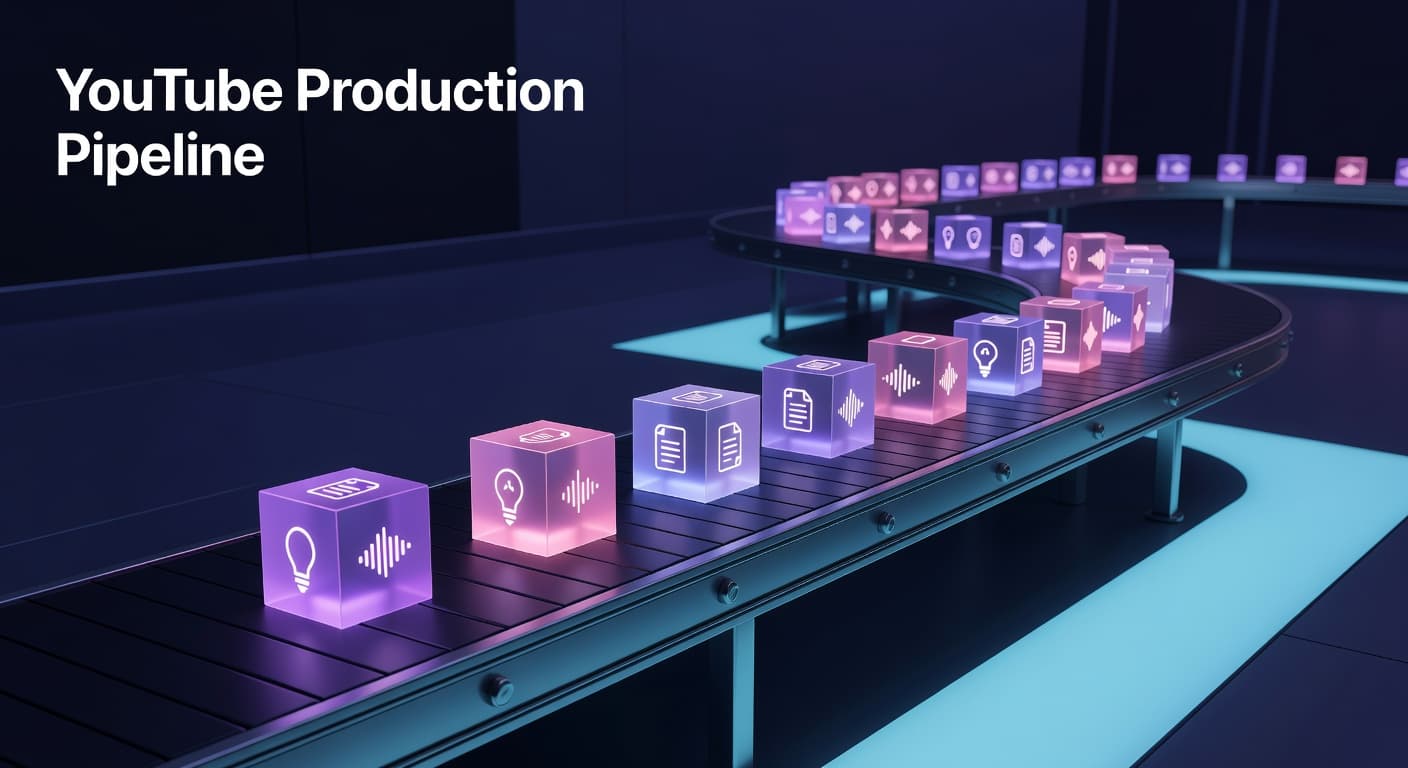
A functional no-edit production pipeline typically breaks down into six sequential stages: ideation, scripting, visual sourcing, audio production, video assembly, and metadata publishing. Each stage has a defined input and output, which is what distinguishes a pipeline from a loose workflow. When one stage finishes, the next begins without ambiguity about what needs to happen. Ideation covers topic research and content validation — identifying which video to make and why it has outsized potential before investing production hours. Scripting transforms the validated idea into a structured, retention-optimized script with a hook, body, and conclusion. Visual sourcing pulls together stock footage, motion graphics, branded text overlays, and proof content that supports what the script says. Audio production converts the script to narration, either via a human recording or a high-quality text-to-speech voice. Assembly combines all assets into a finished video, with timestamps, transitions, and caption layers handled automatically. Finally, metadata publishing generates the title, description, tags, chapters, and thumbnail required for YouTube discoverability. What makes this pipeline particularly powerful for non-editors is that each stage now has dedicated agentic tools that handle execution. Research from industry data shows that AI editing and production tools are saving creators up to 25% of their time per video — but creators who install a proper pipeline structure, rather than using tools ad-hoc, compound those savings across every upload. A clear six-stage system also makes it possible to batch produce: run three videos through ideation on Monday, three through scripting on Tuesday, and so on, keeping every stage active without context-switching costs.
The Six Stages of a No-Edit YouTube Production Pipeline: What Each Stage Involves and Its Output
| Pipeline Stage | What You Do | Output | Time Investment |
|---|---|---|---|
| 1. Ideation | Research trending topics, validate demand, score viral potential | Prioritized video concept with rationale | 30–60 min (or minutes with agentic tools) |
| 2. Scripting | Write retention-optimized script with hook, body, CTA, and visual cues | Production-ready script with citations | 1–4 hours (or minutes with swarm research) |
| 3. Visual Sourcing | Find stock footage, motion graphics, screenshots, and brand assets | Organized asset folder per video | 1–3 hours (or automated via agent) |
| 4. Audio Production | Record voiceover or generate text-to-speech narration | Final audio track synced to script | 30–90 min |
| 5. Video Assembly | Combine audio, visuals, captions, and overlays into a finished file | Export-ready video file | 2–8 hours (or automated assembly) |
| 6. Metadata Publishing | Generate title, description, tags, chapters, and thumbnail | Upload-ready metadata package | 30–60 min (or minutes with templates) |
How Does Pipeline Structure Affect YouTube Algorithm Performance?
Pipeline structure affects YouTube algorithm performance because it directly governs upload consistency — and consistency is one of the clearest signals YouTube uses to determine channel reliability. According to a study cited by industry researchers, channels with consistent weekly uploads received 1.5x more recommendations than channels on irregular schedules, even when overall content quality was comparable. The algorithm interprets a predictable publishing cadence as evidence that a channel is active and trustworthy, which increases the likelihood of videos being surfaced in search results, suggested feeds, and subscriber notifications. YouTube's own Creator Academy documentation reinforces this principle: the platform rewards channels that build habitual viewing patterns with their audience. When subscribers know a new video drops every Wednesday, they anticipate it — and that anticipatory engagement (early clicks, fast watch-through rates, quick comments) sends strong ranking signals in the critical 24 to 48 hours after upload. The challenge is that most creators cannot maintain publishing consistency when every video is built from scratch without a system. Production bottlenecks — usually at the scripting and visual sourcing stages — cause delays that push publish dates back, break audience habits, and signal inconsistency to the algorithm. A properly installed production pipeline removes these bottlenecks by pre-defining what happens at each stage, making it possible to produce at a sustained cadence of one to two videos per week regardless of experience level. For creators using agentic workflows that automate ideation, scripting, visual sourcing, and metadata, the pipeline can support even higher output without a proportional increase in hours.
Seven Common Pipeline Bottlenecks and How to Eliminate Them
- Blank-page scripting delay: Eliminated by using agentic research tools that generate a structured first draft with verified sources in minutes rather than hours.
- Visual sourcing dead-ends: Eliminated by connecting your script directly to a stock footage agent that matches B-roll to each segment automatically, removing manual search entirely.
- Inconsistent voiceover quality: Eliminated by standardizing on a single premium text-to-speech voice profile per channel, ensuring every video sounds identical regardless of recording environment.
- Thumbnail creation bottlenecks: Eliminated by using style-match generation that replicates your channel's existing visual brand automatically from the video title or script.
- Metadata guesswork at upload: Eliminated by generating titles, descriptions, chapters, and tags as a packaged output from the scripting stage rather than writing them separately at publish time.
- Version control chaos across assets: Eliminated by keeping all pipeline outputs (scripts, visuals, audio, metadata) inside a single platform with searchable history so nothing gets lost between stages.
- No documented production playbook: Eliminated by recording what worked for your first 10 pipeline videos and using those patterns as a repeatable template for every subsequent upload.
What Does a Scalable YouTube Pipeline Look Like in Practice?
Scalability in a YouTube production pipeline means the system produces more videos without requiring proportionally more hours. The creators who achieve this have two things in common: they treat the pipeline as a product, not a process, and they use data from each completed video to sharpen the next run through the system. In practice, a scalable pipeline often starts with a weekly ideation session — typically 30 to 60 minutes — where a creator reviews trend data, competitor performance, and audience comment signals to select the next one to three video concepts. From there, each concept moves through scripting, visual sourcing, audio, assembly, and metadata as a sequential unit, with agentic tools handling the execution-heavy stages. Creators who batch these stages — running all three concepts through scripting before moving to visual sourcing — report the most dramatic time savings because they eliminate the cognitive overhead of context-switching between creative modes. The most durable pipelines also include a brief post-publish review loop. After each video goes live, a creator spends 10 to 15 minutes checking the first 48 hours of retention data and CTR, then logs one observation — a hook that worked, a visual that didn't land, a title format that outperformed expectations — back into their production playbook. Over 20 to 30 videos, that log becomes a proprietary dataset specific to their channel, audience, and niche that no generic advice can replicate. This is the compound advantage of a pipeline over ad-hoc production: the system learns alongside the creator.
A Pipeline Is the Structural Advantage Most Creators Skip
Most creators focus on making better videos. The ones who grow consistently focus on building better systems for making videos. A production pipeline without editing removes the biggest friction points — blank-page scripting, manual visual sourcing, guesswork metadata — and replaces them with defined stages that run the same way every time. The practical payoff is upload consistency, which remains one of the clearest levers for algorithmic growth on YouTube. When you never miss a publish date because the system handles execution, the algorithm notices, your audience forms habits, and your channel builds momentum that compounds over months rather than spiking and stalling. For a broader look at the tools and formats that feed into this kind of pipeline — including stock footage strategies, agentic script writing, and thumbnail creation — explore the full guide on YouTube video production without editing skills.
Frequently Asked Questions
What is a YouTube video production pipeline?
A YouTube video production pipeline is a defined sequence of repeatable stages — ideation, scripting, visual sourcing, audio, assembly, and metadata — that takes a video from concept to published upload in a consistent, predictable way. Unlike ad-hoc production, a pipeline means every video follows the same process so creators can batch work, reduce decision fatigue, and maintain upload consistency without editing software.
How do I build a YouTube production workflow without editing skills?
Start by mapping the six pipeline stages — ideation, scripting, visual sourcing, audio production, video assembly, and metadata publishing — and assign a dedicated tool or process to each one. Use agentic research and scripting tools to handle the longest pre-production stages, connect your script to an automated stock footage tool for visuals, use text-to-speech for narration, and generate your metadata as part of the scripting stage rather than at upload time. This removes traditional editing from the equation entirely.
Does upload consistency really affect YouTube channel growth?
Yes — research shows channels with consistent weekly uploads receive up to 1.5x more algorithm recommendations than channels on irregular schedules, even at similar content quality levels. YouTube's algorithm interprets a reliable publishing cadence as a signal of channel trustworthiness, which increases recommendation frequency in search, suggested videos, and subscriber notifications. Early engagement velocity in the first 48 hours after upload — driven by an audience that expects and anticipates new content — also sends strong ranking signals to the algorithm.