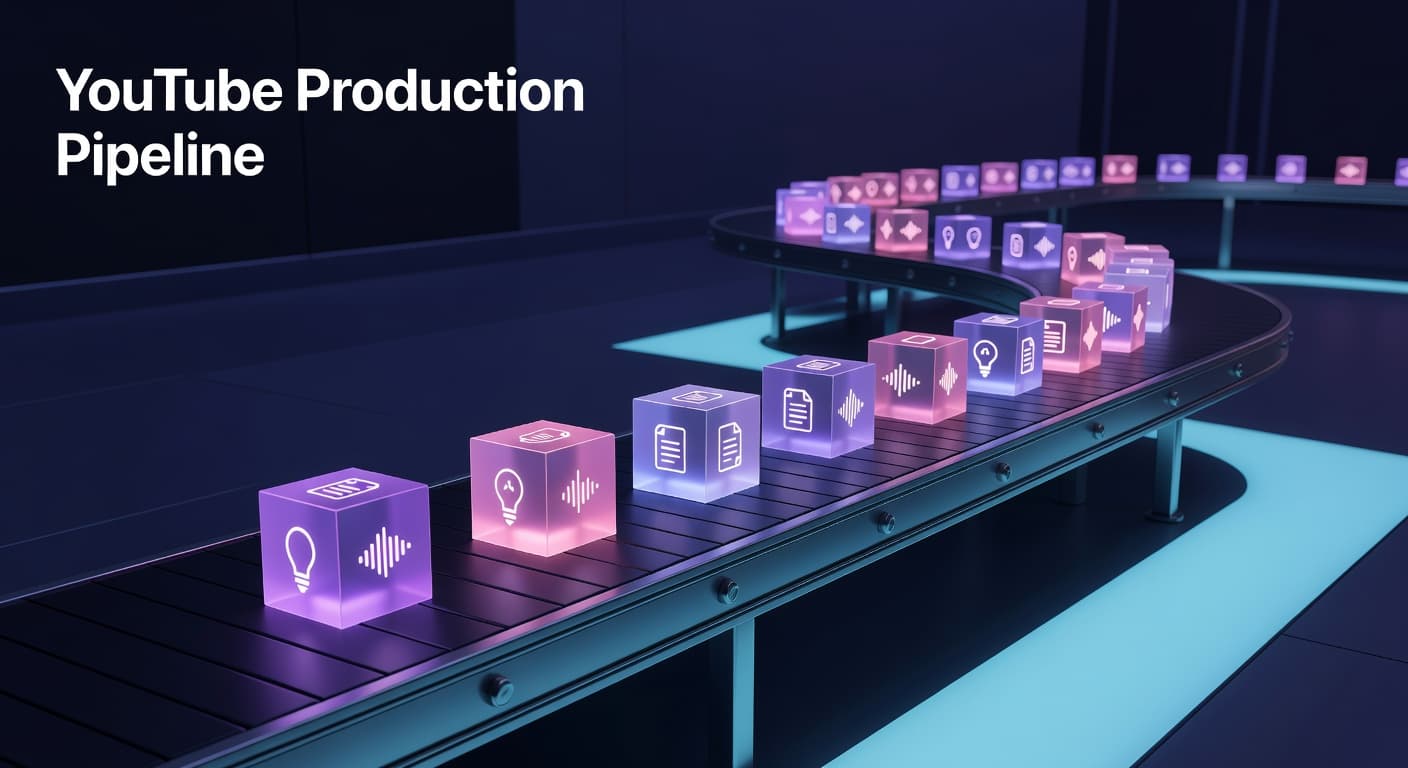
How creators at every level are publishing professional YouTube videos using data-driven, agentic workflows — no timeline experience required
The Editing Barrier Is No Longer a Real Barrier
Ask any aspiring creator what stops them from starting a YouTube channel and you'll hear the same answer again and again. Not the camera. Not the ideas. The editing. Learning to cut clips, sync audio, layer motion graphics, and maintain pacing across a 10-minute video has traditionally required months of practice, expensive software subscriptions, and the patience of someone who genuinely enjoys pushing keyframes at 2 AM.
That era is ending.
In 2026, the landscape of YouTube video production has fundamentally shifted. Agentic workflows now handle the most technically demanding parts of the production pipeline — visual research, timeline assembly, voiceover generation, motion graphics, B-roll sourcing — without asking you to learn a single keyboard shortcut. The gap between having a great idea and publishing a professional video has collapsed from days to hours.
This matters enormously for the math of YouTube growth. Research analyzing platform-wide data shows that 88.4% of videos generate fewer than 1,000 views, while only 3.67% reach 10,000 views — yet that tiny fraction accounts for over 93% of all views on the platform. The channels climbing into that top tier are not necessarily the ones with the best editors. They are the ones making smart content decisions before they press record, then publishing consistently enough for the algorithm to reward them.
YouTube's 2026 roadmap makes one thing crystal clear: the platform now prioritizes viewer retention and engagement above nearly everything else. That means your strategic choices — your hook, your topic selection, your title, your thumbnail — carry more weight than the technical polish of your timeline. When production becomes fast and reliable, you can redirect that creative energy toward decisions that actually move the algorithm needle.
This pillar covers everything you need to understand about producing YouTube videos without traditional editing skills — from the agentic tools and workflows that make it possible, to the content formats that thrive in a no-edit production model, to the data-driven strategy layer that separates channels that grow from channels that stall.
How Agentic Production Workflows Replace Manual Editing
Traditional video editing is a sequential, skill-intensive process. You import footage, cut bad takes, sync audio tracks, add B-roll, layer text overlays, export, and then repeat every correction when something doesn't look right. For creators without a background in post-production, this is where channels go to die. The learning curve is steep. The software is expensive. And the time investment is brutal — professional editors routinely spend 8 to 12 hours on a single 10-minute video.
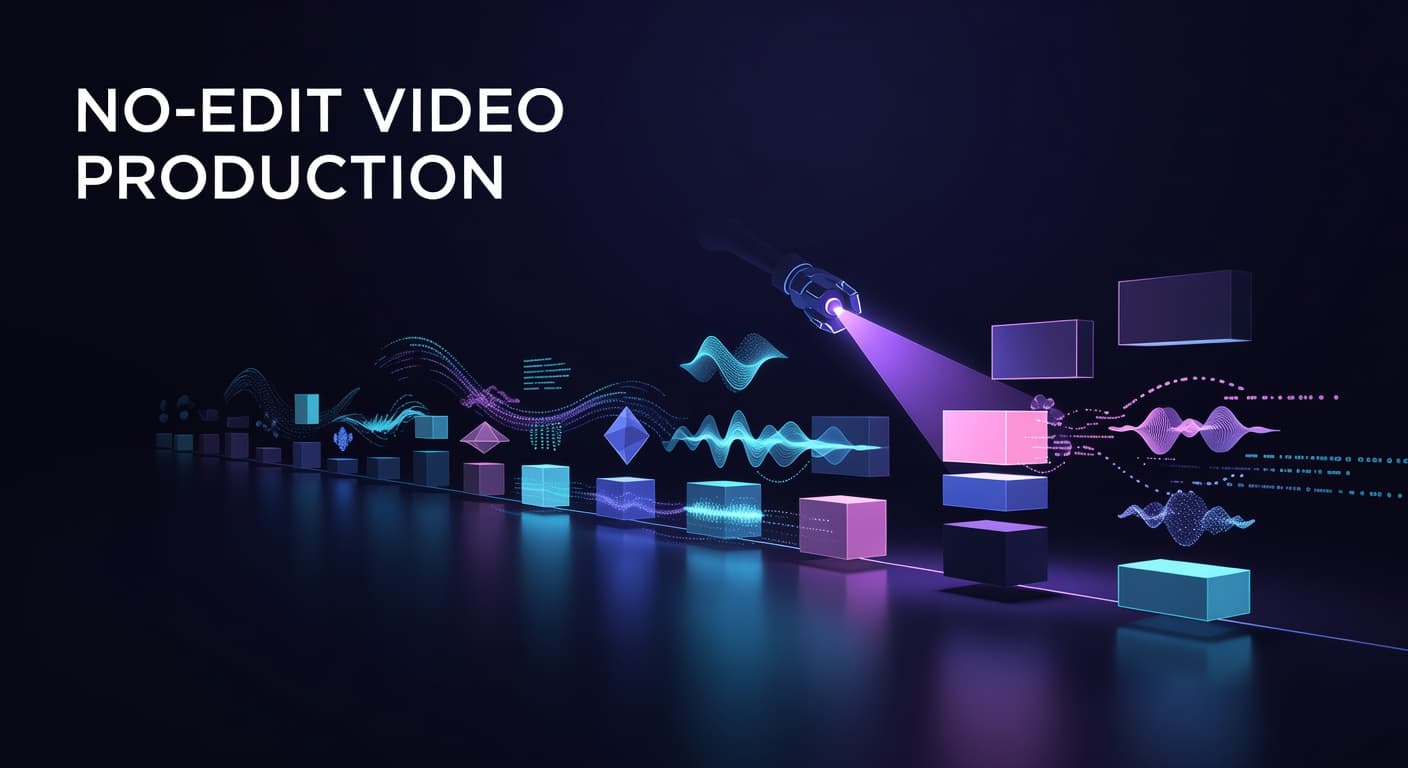
Agentic production workflows invert this entirely. Instead of the creator operating the tools, intelligent agents operate on your behalf. You provide the input — typically a script, a video idea, or a YouTube URL — and a coordinated system of specialized agents handles research, visual sourcing, animation, narration, and assembly simultaneously. The output is a production-ready video that would have previously required a full post-production team.
Here is what that pipeline actually looks like in practice. A visual research agent identifies and sources the right assets for each segment of your script — company logos with transparent backgrounds, product imagery, relevant stock footage, and news screenshots that support your claims. A motion graphics agent generates custom animations for data visualizations, counter effects, and kinetic typography, all synchronized to the moment you mention them in your narration. A voiceover agent converts your script to natural-sounding audio calibrated to match the style and pacing of your target channel. A timeline assembly agent layers all of these elements together with professional transitions, proper pacing, and synchronized captions — automatically.
For existing channels, this is a scaling unlock. A creator who previously produced two videos a month due to editing bottlenecks can now produce eight or ten — without hiring. For new creators, it is a direct on-ramp. Your first video can look like your fiftieth, because the system executing it has already done this thousands of times.
Style matching makes this even more powerful for established channels. By analyzing the visual patterns of your existing content — color palettes, typography choices, composition preferences, text overlay frequency — an agentic production system can replicate your exact aesthetic across every new video. Audience recognition builds. Brand consistency holds. And you never have to manually enforce it.
Traditional Editing vs. Agentic Production: Time and Output Comparison for YouTube Creators
| Production Stage | Traditional Editing (Solo Creator) | Agentic Workflow |
|---|
| Script to Visual Assets | 2–4 hours of manual stock searching | Minutes — agents source logos, footage, and screenshots automatically |
| Motion Graphics & Animations | 4–8 hours (requires After Effects skills) | Auto-generated and synced to narration timestamps |
| Voiceover Recording | 1–2 hours setup, recording, cleanup | Instant text-to-speech in your preferred voice style |
| Timeline Assembly & Editing | 3–6 hours of manual cutting and layering | Automated assembly with transitions and captions |
| Total Time Per Video | 8–20+ hours | 2–4 hours (primarily reviewing and refining) |
| Monthly Output (Solo Creator) | 2–4 videos | 15–30 videos |
Scroll to see more →
Best Content Formats for No-Edit YouTube Production
Not every YouTube format is equally suited to an agentic production model. Understanding which content types thrive without hands-on editing — and why — is one of the highest-leverage strategic decisions you can make before you commit to a production workflow.
Narration-driven formats are the clear frontrunner. Educational explainers, data analysis breakdowns, news commentary, top-ten lists, company deep-dives, finance breakdowns, and history content all rely on voiceover as the primary storytelling vehicle, with visuals supporting the narrative rather than carrying it. This is precisely what agentic workflows excel at. The system takes your script, builds the visual layer around it, and produces a video indistinguishable from one assembled by a professional editor.
Finance and market analysis content is a particularly strong match. When your topic involves current data — stock performance, company earnings, economic indicators — agentic research agents can pull verified financial data in real time before the script is even assembled. Numbers are accurate. Charts animate to the correct figures. And your credibility holds up under audience scrutiny, which matters enormously in high-trust niches like investing.
Faceless channels — channels built entirely around narration and stock visuals without an on-camera presenter — have become one of the fastest-growing formats on the platform. YouTube now has over 2.7 billion monthly users, and a meaningful portion of the most-watched educational, documentary, and commentary content is produced without a traditional camera setup.
Talking-head formats where a presenter appears on camera can also benefit from agentic workflows, particularly for B-roll sourcing, lower-third animations, and automated caption generation. Creators who do appear on camera can use an agentic production system to handle the 60 to 70 percent of post-production that doesn't require their direct involvement, reserving their time for the segments that actually require a human creative touch — pacing decisions, delivery choices, and the emotional beats that no agent can replicate.
The strategic principle here is simple. Lead with your expertise, your research, and your unique perspective. Let an agentic production layer handle the technical translation of that content into a published video. YouTube's algorithm does not reward editors. It rewards retention. And retention follows content quality.
6 YouTube Content Formats That Excel Without Traditional Editing Skills
- Educational Explainers — Narration-led tutorials and how-to content thrive in agentic workflows; visuals are auto-sourced to match each script segment, producing professional results without manual B-roll hunting
- Data and Finance Analysis — Market breakdowns, earnings reports, and economic commentary benefit from real-time data agents that pull verified figures before production begins, ensuring numerical accuracy that builds audience trust
- News Commentary and Reaction — Time-sensitive content requires speed; agentic production compresses the gap between trending topic and published video from days to hours, capturing algorithm momentum before it fades
- Faceless Documentary-Style Videos — History, science, and culture channels combine stock footage with narration to produce high-retention content at scale without any on-camera presence or traditional editing setup
- Company and Product Deep-Dives — Logo sourcing, screenshot capture, and product imagery are auto-handled by visual research agents, making brand-focused content both faster to produce and more visually credible
- Top-N List Videos — Highly structured formats with predictable segment patterns are ideal for automated assembly; the system handles transitions, text overlays, and visual pacing automatically across every segment
Building a Scalable YouTube Production System
Producing one great video without editing skills is achievable on day one. Building a channel that grows consistently — that is the harder problem, and it requires thinking about production as a system rather than a series of isolated events.
The most important insight here is that production speed is not the final goal. Consistent publishing is. YouTube's algorithm rewards channels that upload on a reliable schedule because predictable content signals a healthy, active creator to the recommendation engine. Agentic production workflows are the infrastructure that makes consistency achievable for solo creators who would otherwise face the impossible choice between quality and frequency.
Data-driven strategy must sit at the front of this system, before any production begins. Research analyzing platform-wide performance shows that channels growing fastest in 2026 start with strategic intelligence — analyzing what content performs in their niche, what audience gaps exist, what title and thumbnail patterns drive clicks — and then build production workflows around validated opportunities. Production efficiency only compounds if the content being produced is worth watching.
This is where the idea of a content pipeline becomes practical. In a well-built pipeline, you are simultaneously at different stages with multiple videos: researching and validating an idea, scripting a confirmed concept, reviewing a video that agents have assembled, and publishing one that is ready. When each stage is fast and reliable, you are never waiting on production to catch up with your ideas.
Thumbnails and metadata are the final production layer that no creator should skip. A video that takes two hours to produce via agentic workflow and five minutes to title and thumbnail is still leaving performance on the table. High-performing thumbnails stop the scroll. Optimized titles with strong curiosity gaps drive clicks. Properly structured descriptions with timestamped chapters improve session time and help YouTube's algorithm understand what your content covers.
For new creators, the system advice is straightforward. Start with one content format you understand deeply. Build the agentic workflow around it. Publish six to eight videos with consistent pacing and packaging. Then let retention data — available in YouTube Studio after each upload — tell you which topics and structures are resonating. That feedback loop, compressed by fast production cycles, is how new channels find their footing in months instead of years.
For established creators, the leverage is in scale. If you currently produce two videos per month and your retention metrics are solid, a faster production system does not just save time — it multiplies every growth driver simultaneously. More uploads means more impressions. More impressions means more data. More data means smarter decisions on the next cycle.
Your Ideas Deserve to Be Published — Start the System Today
The old excuse is gone. You no longer need to spend months learning video editing software to publish professional YouTube content. Agentic production workflows have closed that gap, turning scripts into polished, retention-optimized videos in a fraction of the time traditional editing requires.
But production speed is only half the equation. The channels that grow in 2026 are the ones pairing fast, reliable production with data-informed content decisions — knowing which topics to cover, which formats to use, which hooks to write, and which thumbnails to test, all before a single frame is rendered.
That combination — strategic intelligence at the front end, agentic production at the back end — is the real unlock for solo creators at every stage. New creators can launch with the visual quality of established channels. Existing creators can multiply their output without multiplying their workload.
Your competitive advantage on YouTube has never been your ability to push keyframes. It has always been your knowledge, your perspective, and your understanding of what your audience needs. Build the production system that lets all of that reach the people who are looking for it. Then publish. Consistently. That is the whole game.