
How to Write a YouTube Video Script Without Writing Experience
Key Takeaways
- A well-structured YouTube script is the single highest-leverage tool for improving audience retention, which directly drives algorithmic distribution.
- The first 15–30 seconds of your script — the hook — determine whether viewers stay or leave, making it the most critical section to get right.
- The platform-wide average retention across all YouTube videos sits at just 23.7%, meaning a script optimized for 40%+ retention places you well ahead of the algorithmic baseline.
- A research-backed, voice-matched script workflow collapses the trial-and-error learning curve that typically costs new creators months of stalled growth.
- Scripts do not need to be perfect prose — they need to be structured, specific, and honest about the value the viewer will receive in the next few minutes.
Use a proven retention-focused script structure to keep viewers watching and grow faster
You Don't Need to Be a Writer to Script a Great YouTube Video
Writing a YouTube video script without prior writing experience is entirely achievable when you follow a retention-focused structure rather than writing freeform. The goal of a YouTube script is not literary quality — it is to guide a viewer from click to completion by front-loading value, maintaining momentum, and delivering exactly what your title and thumbnail promised. Most new creators assume scripting is a skill reserved for professional writers or experienced communicators. That assumption is what keeps early videos stuck with low watch time and inconsistent growth. In reality, scripting is a system — and systems can be learned and applied immediately, regardless of your background. The reason this matters so urgently is tied directly to how YouTube distributes content. Audience retention is the platform's most heavily weighted quality signal: when viewers watch a significant portion of your video, YouTube serves it to more people. When they bail early, the algorithm moves on. A tight, purposeful script is your most direct lever for influencing that retention number, and it is one you control completely before you record a single frame. This spoke is a practical guide to building that script — structured around the same frameworks that underpin the broader YouTube video production workflow covered in our pillar on producing YouTube content without editing skills.
How Does Script Structure Actually Affect Retention?
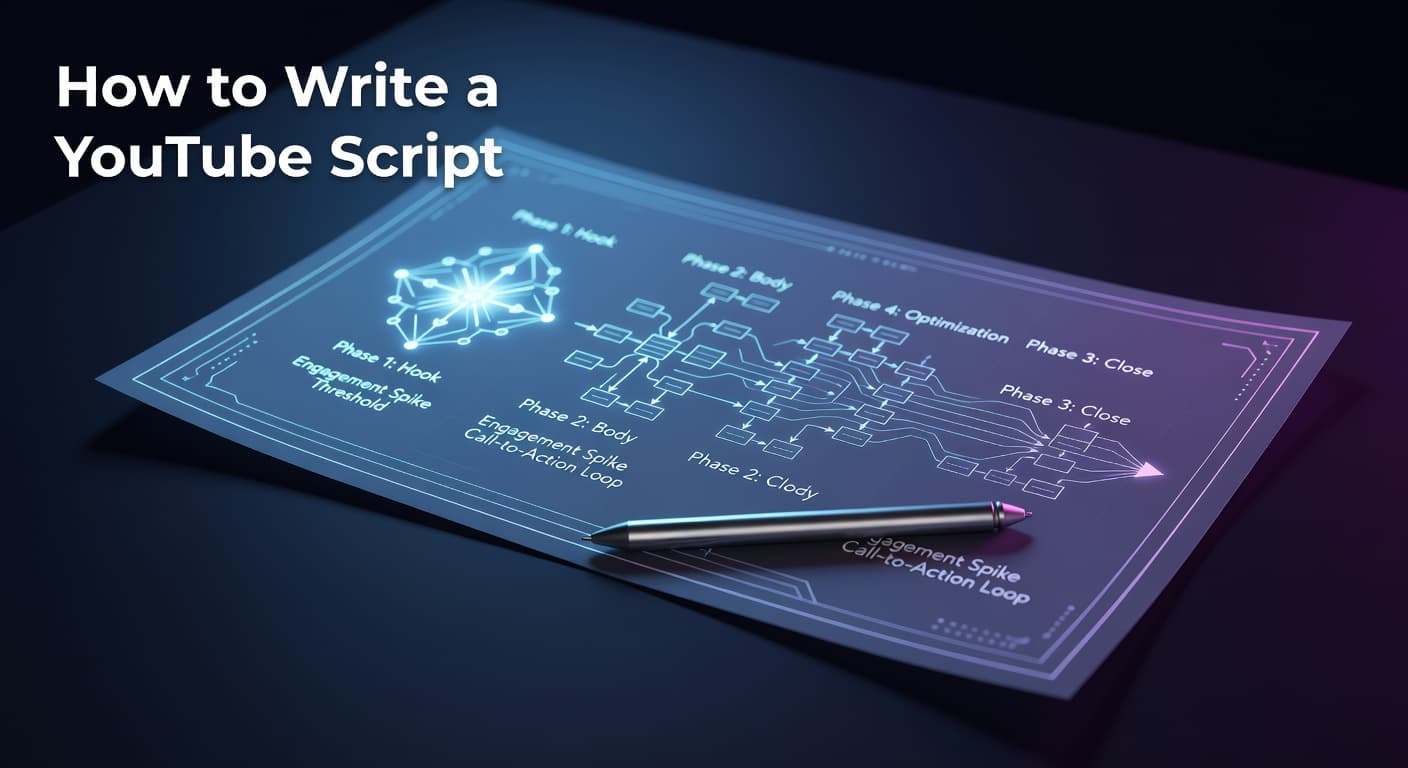
Script structure affects retention because viewers make a stay-or-leave decision within the first 30 seconds of almost every video. According to a May 2025 benchmark study by Retention Rabbit, videos where more than 65% of viewers make it past the first minute show 58% higher average view duration across the rest of the video. That compounding effect makes the opening section of your script disproportionately important compared to everything that follows. A retention-optimized script is built around four distinct phases: the hook (first 15–30 seconds), the setup (30–90 seconds establishing the promise and stakes), the value delivery (the core body of content), and the close (a CTA that rewards the viewer for staying). Each phase serves a specific audience psychology function. The hook creates urgency — it answers the viewer's implicit question, "Why should I keep watching this, right now?" The setup confirms they made the right choice to stay. The body delivers the promised value in organized, digestible chunks. The close converts attention into an action. Interestingly, the most common scripting mistake among beginners is spending too long in the setup phase — explaining background context the audience already has — while rushing the value delivery section where retention is most fragile. Structuring your script with explicit section markers for each phase prevents this drift and keeps your pacing aligned with where viewers are most likely to drop off.
YouTube Script Phase Breakdown: Purpose, Timing, and Retention Impact
| Script Phase | Approximate Timing | Primary Purpose | Retention Signal |
|---|---|---|---|
| Hook | 0:00 – 0:30 | Create urgency; deliver the core promise immediately | Critical — this is where 55%+ of viewers abandon on average |
| Setup / Context | 0:30 – 1:30 | Confirm the value and establish why this matters now | High — lose viewers here by over-explaining background |
| Value Delivery (Body) | 1:30 – end minus 60s | Deliver on every promise made in hook and title | Moderate — use pattern interrupts every 20–40 seconds |
| Close / CTA | Final 45–60 seconds | Reward the viewer; prompt one specific next action | Lower drop-off risk — loyal viewers remain; keep it concise |
What Does a Beginner-Friendly Script Outline Actually Look Like?
A practical script outline for a beginner does not require pages of fully written prose. According to YouTube's Creator Academy guidance on audience retention, the most effective approach is to script the hook and close word-for-word while using structured bullet points for the body sections — a method often called a hybrid outline. This preserves your natural speaking rhythm in the sections viewers are most tolerant of looseness, while protecting the two highest-stakes moments with precision. For a 10-minute video at a standard speaking pace of approximately 150 words per minute, you need roughly 1,500 words of spoken content. A hybrid outline might look like: three to five fully scripted sentences for the hook, keyword phrases and talking points for each body section (rather than fully written paragraphs), and a two to three sentence scripted close with a single clear CTA. Notably, the body of your script should be organized into chapters — distinct segments each resolving one specific sub-promise you made in the hook. This modular structure not only improves retention by giving viewers a sense of forward progress, but it also maps directly to YouTube chapter timestamps in your video description, which YouTube Creator Academy identifies as a discoverability and satisfaction signal. For new creators, each chapter should cover one idea completely before moving to the next, with a brief transitional phrase that teases what is coming — a micro-hook that resets viewer commitment for the next segment.
Step-by-Step Script Writing Workflow for YouTube Beginners
- Define your core promise in one sentence before writing anything — every word in your script must serve this promise or be cut
- Write your hook last, not first — draft the body value delivery first so you know exactly what you are promising in the opening 30 seconds
- Use the 'problem-evidence-solution' structure for each body chapter: state the problem the viewer is experiencing, provide a specific data point or example that validates it, then deliver the solution clearly
- Read your script aloud at normal speaking pace and time each section — if a section runs more than 2 minutes without a visual cue or new talking point, break it into two smaller sections
- Apply one pattern interrupt per chapter: a direct question to the viewer, a contrast statement, or a short specific example — these reset attention without requiring editing skill
- Write your close as a restatement of the core promise delivered, followed by a single next-action request — avoid stacking multiple CTAs which dilute click-through on any one of them
Why Data-Driven Script Research Compounds Your Growth
The gap between a script that performs and one that stalls is rarely about writing talent — it is almost always about the quality of the research and the specificity of the information inside the script. Viewers on YouTube are sophisticated. They can detect when a script is built on shallow or generic information within the first two minutes, and retention drops reflect that signal immediately. Data-driven scripting means grounding every claim in your video in a verifiable source, building your content around questions real viewers are actively asking in your niche, and calibrating your depth to what your target audience actually needs — not what feels comprehensive to you as the writer. When you treat script research as a systematic process — identifying the three to five questions your target viewer most urgently wants answered, then building each body chapter around one of those questions — you create a video that serves search intent and earns sustained watch time simultaneously. This is where the broader production workflow comes full circle. A research-backed script is the foundation that makes every downstream element — narration, stock footage selection, visual pacing — more coherent and effective. Channels that adopt this approach consistently report improving from below-average retention toward the 40–50% range that triggers meaningfully stronger algorithmic distribution.
Your Script Is the Cheapest Leverage Point You Have
You do not need writing experience to script a high-performing YouTube video — you need a structure, a clear promise, and the discipline to deliver on it before reaching for the close. The four-phase framework (hook, setup, body chapters, close) gives you that structure immediately, regardless of your starting skill level. Platform-wide average retention sits at 23.7%. Every creator who consistently scripts with retention in mind has a direct path to outperforming that baseline. Start with a one-sentence promise, draft your body chapters first, write your hook last, and read it aloud before you record. For a deeper look at how scripting fits into a complete production system — from idea to finished video without editing software — explore the pillar guide on YouTube video production without editing skills.
Frequently Asked Questions
How long should a YouTube video script be for a 10-minute video?
A 10-minute YouTube video at an average speaking pace of 150 words per minute requires approximately 1,400 to 1,600 words of spoken content. If you plan to use visual elements like B-roll or on-screen text that replace verbal explanation, reduce your word count by 20 to 30 percent to avoid a script that runs longer than your intended video duration.
Do you need to write a full script or can you use an outline for YouTube?
Both approaches work depending on your experience level and content format. A hybrid approach — scripting the hook and close word-for-word while using structured bullet-point outlines for body sections — gives you the precision where it matters most without over-engineering the sections where natural delivery actually benefits retention. Fully improvised videos without any script structure consistently underperform on average view duration.
What is the most important part of a YouTube script for keeping viewers watching?
The hook — the first 15 to 30 seconds of your script — is the single most important section for viewer retention. Research shows that videos where more than 65 percent of viewers pass the one-minute mark achieve 58 percent higher average view duration across the rest of the video, making the hook a compounding investment in every second that follows it.