How to Turn Podcasts Into YouTube Videos Without Editing Skills
Key Takeaways
- You can convert a podcast into a YouTube video without editing by pairing the audio with an automated visual layer and letting an agentic workflow render the file.
- Start by publishing full episodes with a waveform or auto-matched b-roll, then let the same workflow cut short clips for discovery.
- YouTube now reaches more than 1 billion monthly podcast viewers, making it the single largest podcast audience in the world.
- Repurposing existing audio into video is the lowest-effort way to double a podcast's reach without touching a timeline editor.
A no-edit path to convert podcast audio into YouTube videos that actually get watched
Your Podcast Is Already Half a YouTube Video
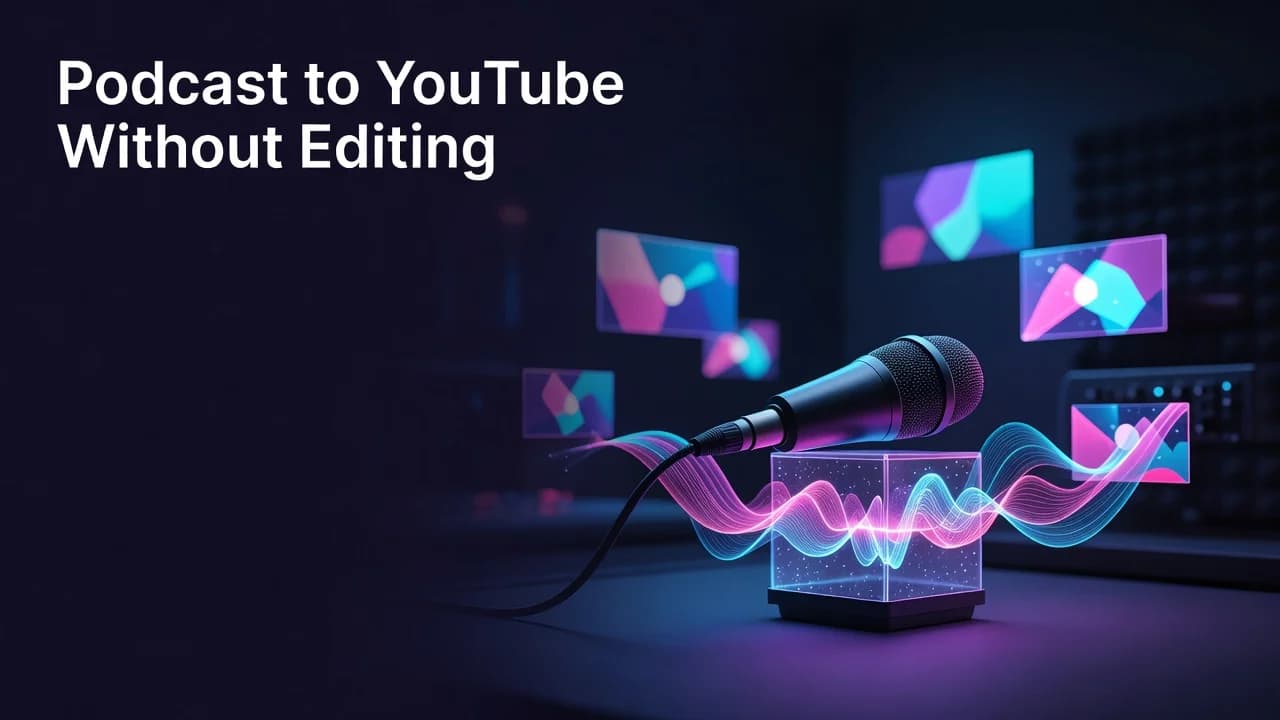
You can turn a podcast into a YouTube video without any editing skills by pairing your existing audio with a simple visual layer — a static cover, an animated waveform, or automatically matched b-roll — and letting an agentic workflow assemble the finished file. There is no timeline editor involved: you supply the audio or transcript, and a script-to-video system handles the visuals, captions, and rendering for you. Most podcasters already do the hard part. They research, record, and publish episodes every week. Then that audio sits on a listening app, invisible to the largest video search engine on earth. That is the gap. YouTube has quietly become the place people go to watch podcasts, not just hear them — and the creators who show up there are winning an audience their audio-only competitors never see. The problem is that "making it a video" sounds like a second full-time job: cameras, lighting, editing software, hours in a timeline. It is not. The workflow below treats your finished episode as raw material and builds the video around it automatically. In this guide you will learn what visual formats actually retain viewers, how a no-edit production pipeline turns one audio file into a published video, and how to spin the same episode into short clips that feed the algorithm — all without opening an editor once.
Why Turn Podcasts Into YouTube Videos?
Because that is where the audience moved. YouTube now reaches more than 1 billion monthly viewers of podcast content worldwide, and roughly one in three U.S. podcast listeners — about 33% — name it their primary platform, ahead of every audio-first app. Audio-only distribution leaves that entire pool untouched. When you convert podcast audio to a YouTube video, you inherit search, suggested-video, and Shorts discovery that no listening app offers. A single evergreen episode can keep surfacing in search for years, pulling in new listeners while you sleep. There is also a watch-time advantage: living-room viewing of podcast content has exploded, meaning people are treating video podcasts like television, running full episodes on their TVs. That changes the math on session time — the metric YouTube rewards hardest. Repurposing existing episodes is the highest-leverage move a podcaster can make, because the content already exists and already performed once. You are not creating a new asset. You are unlocking a second, larger audience for one you already own.
How Does A No-Edit Workflow Work?
The trick is letting software make the visual decisions a human editor normally would. Instead of dragging clips across a timeline, you hand an agentic pipeline your transcript, and it reads the content, decides which format fits each segment, sources matching b-roll or motion graphics, adds burned-in captions, and renders the finished file. According to Edison Research, YouTube leads all podcast platforms with roughly 33% of U.S. listeners, and the same research shows video podcast consumption climbing fastest on connected TVs — so the format you choose genuinely affects retention. Static waveform videos are the fastest to produce and work fine for loyal subscribers who click to listen. But auto-matched b-roll and periodic on-screen text hold casual browsers far longer, which matters because YouTube's own Creator resources consistently point to audience retention as a core ranking signal. The practical best practice: publish full episodes with the lightest visual treatment that still holds attention, then invest the saved time into clipping. A finished podcast is a batch of raw material — one recording can yield a full-length upload, several Shorts, and a set of searchable titles, none of which require you to touch an editor.
Comparing no-edit visual formats for podcast-to-YouTube videos by effort and retention
| Visual Format | Production Effort | Best For |
|---|---|---|
| Static branded frame | Lowest — one image, no motion | Loyal subscribers who click to listen, audio-first channels |
| Animated waveform | Low — auto-generated from audio | Full-episode uploads where the conversation carries attention |
| Auto-matched b-roll | Medium — workflow sources footage | Reaching new, casual viewers who need visual movement |
| Clipped vertical Shorts | Low — workflow cuts from full episode | Discovery, feeding the algorithm, and channel growth |
Building A Faceless Podcast YouTube Channel
Here is where this gets interesting for creators without a studio. You do not need to appear on camera at all. A faceless podcast YouTube channel can run entirely on audio plus an automated visual layer — interview shows, solo commentary, narrated deep dives, even AI-narrated scripts. The trend is only accelerating. As connected-TV viewing normalizes video podcasts, expect YouTube to keep rewarding channels that publish consistently in this format. The creators who win will be the ones who treat production as a repeatable system rather than a per-episode grind. Build the workflow once. Then every new episode flows through it: audio in, video out, clips generated, titles optimized. That consistency compounds. A channel publishing weekly video episodes plus daily clips generates far more surface area for discovery than one publishing audio alone — and it costs almost no extra time once the pipeline exists.
One Recording, A Much Bigger Audience
Turning podcasts into YouTube videos is no longer a production project — it is a distribution decision. The audio already exists. The audience is already on YouTube, more than a billion of them every month. What stood in the way was the editing, and agentic workflows have removed that barrier entirely: audio and a transcript go in, a captioned, visual-layered video comes out, and short clips follow automatically. Start with your best-performing back-catalog episode, run it through a no-edit pipeline, and publish. Then build the system so every future episode flows through it without extra effort. For the full picture on producing polished uploads without touching a timeline, explore our pillar guide on YouTube video production without editing skills — podcast repurposing is one of the fastest on-ramps into it.
Frequently Asked Questions
How do I turn a podcast into a YouTube video without editing?
Supply your episode's audio or transcript to an agentic video workflow, choose an automatic visual layer such as a waveform or matched b-roll, and let it add captions and render the finished file. You review the output rather than editing a timeline, so no editing software or skills are needed.
Do podcast videos on YouTube actually get more views than audio-only?
Yes — YouTube now reaches over 1 billion monthly podcast viewers and is the most-used podcast platform in the U.S., so publishing video unlocks search, suggested, and Shorts discovery that audio apps do not offer. A single episode can keep attracting new viewers for years through search alone.
Can I start a faceless podcast YouTube channel without showing my face?
Absolutely. A faceless podcast channel runs on audio plus an automated visual layer — waveforms, b-roll, or on-screen text — so you never appear on camera. Build the workflow once and every new episode can be converted into a video and short clips automatically.