How to Use an Agentic Video Workflow to Produce YouTube Videos Automatically
Key Takeaways
- An agentic video workflow executes every production step — visual research, motion graphics, voiceover, B-roll assembly, and timeline rendering — from a single script input, with no editing software required.
- Creators using agentic production pipelines compress what traditionally takes 8–12 hours of editing into under 2–4 hours of reviewing and refining finished output.
- Style template matching in agentic workflows means established creators can replicate their exact visual brand automatically across every new video, maintaining consistency at scale.
- The most effective agentic pipelines integrate data-driven visual research — sourcing accurate logos, company imagery, and proof screenshots — rather than relying on generic stock media alone.
- Solo creators who adopt agentic video workflows can realistically triple their upload frequency without adding headcount, directly compounding their algorithm momentum.
How autonomous production pipelines take your script to a finished, publish-ready video without editing
The Editing Bottleneck Is the Biggest Hidden Problem on YouTube
An agentic video workflow is a multi-step production system where specialized autonomous processes handle each stage of video creation — visual sourcing, motion graphics, narration, B-roll selection, and timeline assembly — based on a script input, delivering a finished video without any manual editing. For YouTube creators, this means the journey from written script to publish-ready upload can happen in a single automated run, entirely without touching Premiere, After Effects, or any traditional editing tool. Every creator eventually hits the same wall. You have more ideas than you have production hours. Scripting one video might take two hours. But editing that same video — sourcing B-roll, placing graphics, syncing narration, cutting transitions — can devour another eight to twelve. That math doesn't work if you want to publish consistently, and YouTube's algorithm rewards consistency above almost everything else. Agentic video production changes that equation entirely. Instead of you coordinating between research, editing, and rendering tools, an agentic system acts as a virtual production team: one process handles visual research and asset sourcing, another builds motion graphics and animated data sequences, another assembles the timeline with synchronized captions. The system doesn't wait for your input at each step — it plans, decides, executes, and delivers. The result is a production workflow that scales with your ambition rather than capping out at your available editing hours. This guide covers exactly how agentic video pipelines work, what they actually produce, and how creators at every level can put them to work building consistent, professional-quality YouTube content.
How Does an Agentic Video Pipeline Work End to End?
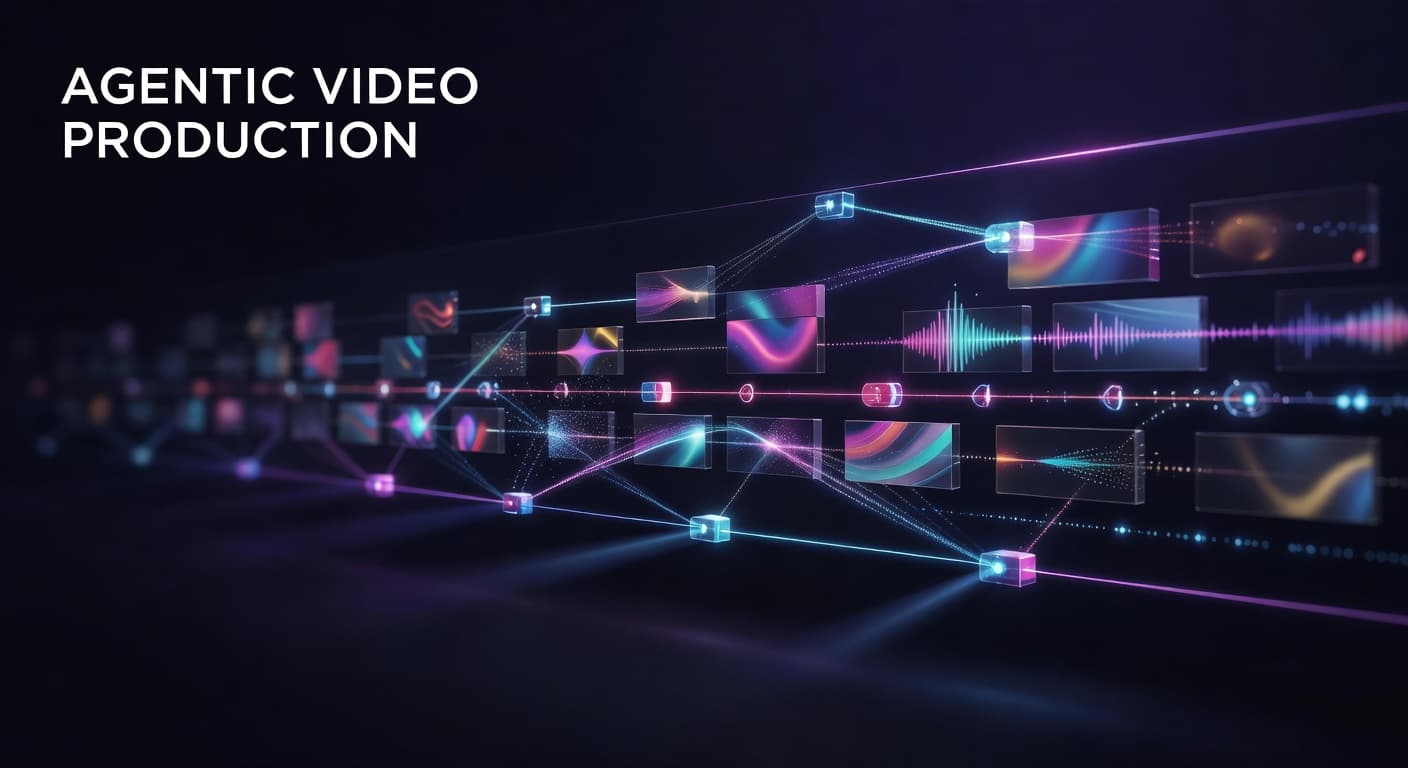
An agentic video pipeline treats your script as the single source of truth and coordinates multiple specialized processes that run in sequence — and in some cases in parallel — until a finished video is ready for export. The workflow typically begins with intelligent content analysis: the system reads your script, identifies the visual intent behind each segment, and determines what types of assets are needed at each point in the timeline. From there, a visual research agent sources high-fidelity images, brand logos with transparent backgrounds, product shots, and relevant proof content like news screenshots. A separate motion graphics process builds animated sequences for data points, counters, or comparison graphics. A narration engine converts the script to synchronized audio. And a final assembly process layers all assets onto a timeline with captions, transitions, and color-consistent visual treatment. The critical distinction between an agentic pipeline and a simple template tool is decision-making. Template-based editors require you to make choices at every step — you tell it what image to use, where to place text, when to cut. An agentic system makes those decisions autonomously based on the content of your script and a style reference. According to Andreessen Horowitz's analysis of the agentic video editing space published in January 2026, video agents will 'blow out the supply curve for quality video — the kind of content that requires days or weeks from professional video editors today.' For YouTube creators, that compression in production time directly translates to more videos, more impressions, and stronger algorithmic momentum without hiring an editor or learning a new software stack.
Traditional video editing vs. agentic video production: time and effort comparison by production stage
| Production Stage | Traditional Editing (Est. Hours) | Agentic Pipeline (Est. Hours) | Who Does the Work |
|---|---|---|---|
| Visual research & asset sourcing | 1.5 – 3 hrs | Automated | Agent process |
| Motion graphics & data animation | 2 – 4 hrs | Automated | Agent process |
| Narration / voiceover recording | 0.5 – 1 hr | Automated | TTS engine |
| Timeline assembly & sync | 2 – 3 hrs | Automated | Agent process |
| Color grading & visual polish | 0.5 – 1 hr | Automated | Agent process |
| Creator review & refinement | N/A | 1 – 2 hrs | You |
| Total | 6.5 – 12 hrs | 1 – 2 hrs | Majority automated |
What Does an Agentic Workflow Actually Produce for Your Channel?
The output of an agentic video pipeline isn't a rough cut or a starting point — it's a production-ready video assembled to professional standards. This distinction matters enormously for creators who've tried template-based tools and found them limiting. A well-built agentic pipeline handles several output layers simultaneously: accurate brand and company imagery sourced and validated for resolution and format compatibility; custom animated sequences for statistics, comparisons, and data visualizations synchronized to the exact moment the narration references them; proof content like news article screenshots or social post captures embedded as visual evidence; and stock B-roll selected not just by keyword match but by visual coherence with the segment's content and aesthetic tone. Style consistency is one of the most underrated outputs of an agentic pipeline, especially for established creators. When you feed the system reference videos from your existing channel, it analyzes your visual language — color palette, typography choices, overlay frequency, pacing rhythm — and replicates those patterns across every new generation. YouTube Creator Academy consistently emphasizes that channel identity and packaging consistency are key signals in how returning viewers recognize and trust a channel. An agentic workflow enforces that consistency automatically, even when you're publishing multiple videos per week. For new creators, this means establishing a professional visual identity from your very first upload rather than developing it through years of iteration. Either way, what comes out the other side is a video that competes visually with channels that have dedicated production teams — without requiring you to become a video editor.
Why Agentic Production Multiplies Your Algorithm Momentum
Consistency is the variable that most separates growing YouTube channels from stagnant ones — and agentic production is the most direct way to achieve it without sacrificing quality or burning out. Upload frequency matters because each new video creates a new opportunity for YouTube's recommendation system to surface your channel to both subscribers and new viewers. Channels that publish weekly versus monthly don't just get four times the exposure opportunities — they accumulate algorithm data faster, training the system on who watches their content and when to recommend it. An agentic video workflow directly removes the bottleneck that makes consistent publishing difficult: editing time. When a creator frees 6–10 hours per video from manual post-production, those hours can go back into research, scripting, and strategy — the elements that determine whether a video concept has genuine viral potential before any production begins. Pair this with a data-driven approach to content planning — using channel analytics, competitor outlier analysis, and audience sentiment research to decide what to produce — and you have a creator who is publishing more often, with better-researched ideas, and with production quality that competes with channels ten times their size. That combination is what compounds into measurable channel growth over months, not years. The agentic video pipeline doesn't replace your creative vision; it removes the technical ceiling that would otherwise limit how often you can act on it.
Your Script Is the Work — Let the Pipeline Handle the Rest
The fundamental shift in agentic video production isn't just about saving time. It's about redirecting your energy toward the parts of content creation where human judgment actually matters: identifying what your audience needs, crafting a compelling narrative, and refining the ideas that data suggests have real breakout potential. The technical assembly — sourcing the right visuals, building the animations, syncing narration to the timeline — is execution, not creativity. Agentic pipelines handle execution at a level that previously required a full production team. Whether you're publishing your first video or your five hundredth, the practical impact is the same: more videos produced per week, higher visual consistency across your catalog, and production time recaptured for strategic work. If you want to go deeper on the full landscape of producing professional YouTube content without editing skills, the main guide on YouTube video production without editing skills covers every component of a modern no-edit workflow. Start with your script. The pipeline takes care of the rest.
Frequently Asked Questions
What is an agentic video workflow for YouTube?
An agentic video workflow is an automated production system that takes your written script as input and autonomously executes every subsequent production step — visual research, motion graphics creation, narration synthesis, B-roll selection, and timeline assembly — delivering a finished, publish-ready YouTube video without manual editing. Unlike template tools, agentic pipelines make contextual decisions at each step based on your script content and a style reference, rather than requiring you to make those choices manually.
Can I use an agentic video pipeline without any video editing experience?
Yes — agentic video pipelines are specifically designed for creators without video editing experience. The entire technical workflow, including asset sourcing, animation, timeline sequencing, and rendering, is handled autonomously by the system. Your primary input is a well-written script and a style reference, and your primary role after the run completes is reviewing the output and flagging any targeted refinements rather than manually building the video yourself.
How long does an agentic video production run take?
A typical agentic production run for an 8–12 minute YouTube video takes approximately 30–60 minutes from script submission to finished output, compared to the 6–12 hours a traditional manual editing workflow requires for the same length of video. The exact time depends on the complexity of the script's visual requirements — data-heavy content with multiple animated sequences may take slightly longer than narration-driven content with primarily stock footage.