
YouTube Audience Retention Curve: How to Read and Fix Drop-Off Points
Key Takeaways
- The average YouTube video retains only 23.7% of viewers overall — hitting 40%+ puts you significantly ahead of most creators on the platform.
- More than 55% of viewer drop-off happens within the first 60 seconds, making your hook the single highest-leverage editing decision you can make.
- Improving your channel-wide average retention by just 10 percentage points correlates with a 25%+ increase in impressions from YouTube's recommendation system.
- Retention curve spikes — moments where the graph rises — reveal the exact content your audience loves most and wants you to replicate.
- YouTube now measures session-level retention, so how viewers flow between your videos matters as much as per-video retention numbers.
Read every drop-off point in your retention graph and fix what's hurting your watch time
Your Retention Curve Is Telling You Exactly What's Wrong
Your YouTube audience retention curve is a timestamp-level map of where viewers stayed, where they left, and what made them rewatch — it's the most direct signal YouTube gives you about content quality. Reading it correctly means you can stop guessing why a video underperformed and start making changes that actually move the algorithm in your favor. Here's the problem most creators run into: they check their retention percentage as a single number, decide it's "okay" or "bad," and move on without doing anything useful with the data. But the shape of the curve — the steep early plunge, the plateau in the middle, the sudden dip at minute four — is where the real story lives. Each of those moments is a timestamp that maps back to a specific creative decision you made, and every one of them is fixable once you know what to look for. This is a deep-dive companion to our broader guide on YouTube video performance analysis. Where that guide covers the full landscape of metrics your channel produces, this post focuses specifically on reading, interpreting, and acting on your retention graph — the metric that arguably has the most direct relationship with how aggressively YouTube distributes your content to new viewers.
How Does the Retention Curve Shape Affect Algorithm Distribution?
YouTube's recommendation system doesn't just count views — it weighs how satisfying those views were, and the retention curve is its primary evidence. According to a 2025 benchmark study analyzing over 150 million minutes of YouTube watch data, the average video retains just 23.7% of its audience overall, and only 16.8% of all videos on the platform surpass the 50% retention mark. That gap between 23% and 40% is precisely where algorithm distribution lives — channels that consistently hold 40% or above are operating in a fundamentally different distribution tier than the majority of creators uploading every day. The relationship is more concrete than most creators realize. Channels that improve their channel-wide average retention by just 10 percentage points see a correlated 25% or greater increase in impressions from YouTube's recommendation system. That's not a marginal improvement — it's the kind of step-change that moves a channel from stagnation to consistent growth. The curve shape matters too, not just the average. A gradual, gently sloping line signals sustained engagement and tells YouTube the video delivered on its promise throughout. A steep early plunge followed by a flat middle tells a completely different story: the hook didn't earn the viewer's time, but those who pushed past it found value. YouTube reads both patterns differently when deciding how broadly to push your content.
YouTube Audience Retention Benchmarks by Video Length — What 'Good' Looks Like by Format
| Video Length | Strong Retention Target | Excellent Retention Target | Primary Risk Zone |
|---|---|---|---|
| Under 2 minutes | 50–70% | 70%+ | First 15 seconds |
| 2–5 minutes | 60%+ | 70%+ | First 30 seconds |
| 5–10 minutes | 50%+ | 60%+ | First 60 seconds & mid-roll |
| 10–20 minutes | 40–60% | 60%+ | Hook + minutes 3–5 transition |
| 20+ minutes | 35–50% | 50%+ | Every major topic transition |
| YouTube Shorts | 80%+ | 90%+ (loop) | First 3 seconds swipe-away |
What Do the Different Patterns on Your Retention Graph Actually Mean?
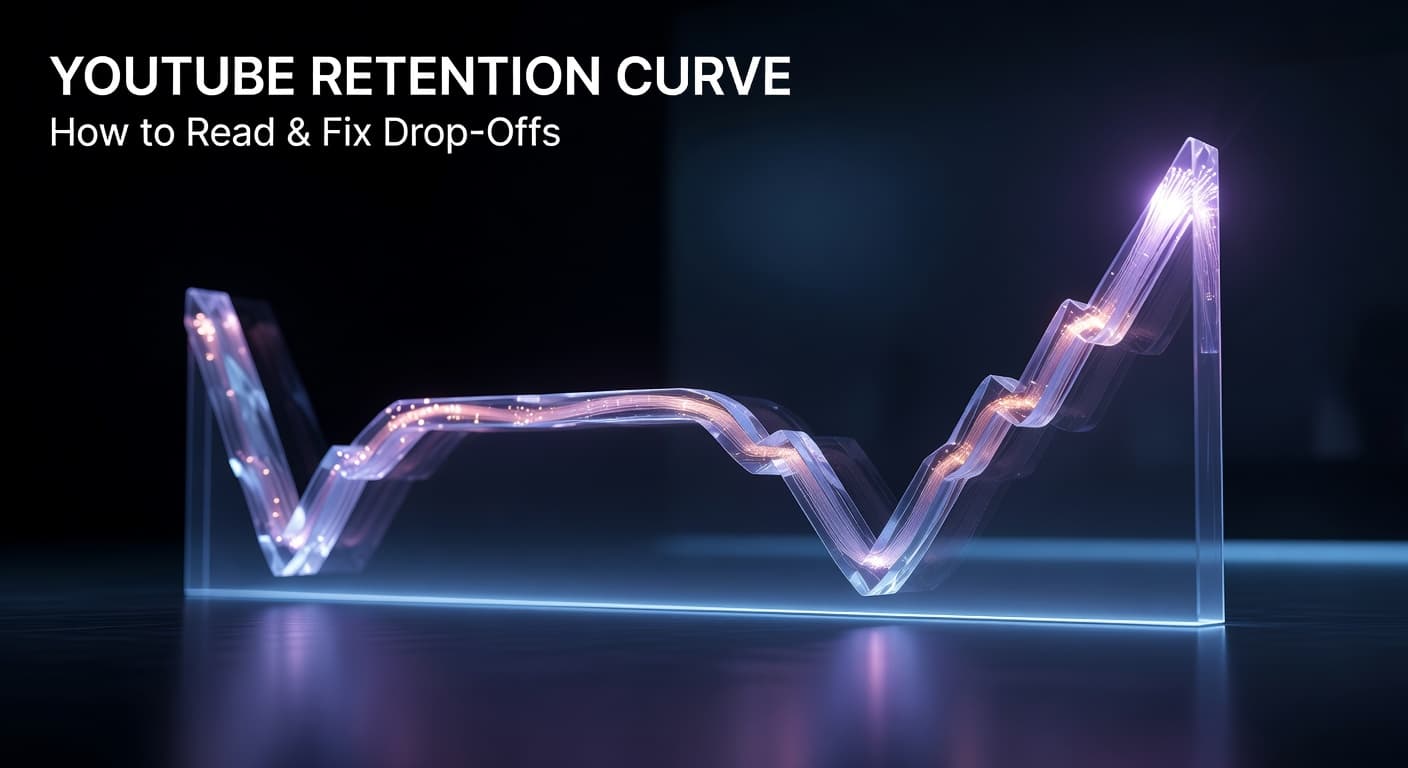
Once you're inside YouTube Studio under Analytics > Content > Audience Retention, you'll see a curve that tells one of several distinct stories — and learning to read them fluently is what separates creators who iterate strategically from those who edit by instinct. According to YouTube's Creator Academy documentation on audience retention, the graph displays the percentage of viewers still watching at each moment of your video, plotted as a continuous line from 0% to 100%. A steep drop in the first 30 seconds almost always signals a hook problem. Research from 2025 benchmark data shows that 55% or more of total viewer drop-off happens within the first minute, and strong intros that hold above 65% of viewers correlate with 58% higher average view duration across the rest of the video. If your curve plunges before the 30-second mark, your intro isn't delivering on what the title and thumbnail promised — it's asking viewers to wait for a payoff they're not confident is coming. Spikes in the curve are gold. When the line rises above where it was a moment before, it means viewers are rewinding to rewatch that moment — a concrete signal that what you said or showed had exceptional value. Those timestamps tell you exactly what content to double down on. Conversely, a dip of 4% or more in remaining audience at any point is a warning: scrub to that timestamp, figure out what happened — a long tangent, a visual that didn't match the audio, a pacing stall — and edit that pattern out of future videos. One additional underused insight: YouTube Studio lets you segment the retention graph by new versus returning viewers. If returning viewers hold through the whole video but new viewers drop sharply at the 30-second mark, your hook is failing cold audiences — and that's a growth ceiling you can directly address.
Six Retention Curve Patterns and What Each One Requires From You
- Steep cliff in first 30 seconds: Your hook isn't delivering on the title or thumbnail promise — rewrite your intro to front-load the core value, cut filler, and get to the point within 15 seconds.
- Consistent gradual slope from start to finish: Normal for longer videos, but if the slope is steeper than your channel average, tighten pacing by cutting any section that doesn't directly advance the main point.
- Sudden single drop at one timestamp: A specific moment broke immersion — a tangent, an audio issue, a confusing visual, or a pace shift. Find that timestamp, identify the cause, and eliminate that pattern in future edits.
- Flat plateau in the middle of the video: This is a strong section — viewers are locked in. Study what's happening in that segment (pacing, storytelling style, visual variety) and engineer similar passages into every video.
- Rising spike on the curve: Viewers rewound here because the moment was exceptionally valuable or entertaining. This is a direct content request — build more videos or sections around exactly this topic and format.
- Sharp drop at the end only: Your content held well but your outro lost people. Shorten the ending, move your CTA earlier, and use end screens to bridge viewers directly to another video rather than letting them navigate away.
Session Retention Is Now the Metric That Amplifies Everything Else
Per-video retention has always mattered, but the way YouTube measures channel health has expanded significantly. The platform now weighs session-level behavior — how viewers flow between your videos, from Shorts to long-form to livestreams — as a signal of channel quality that amplifies individual video retention scores. A creator whose audience watches one video and immediately clicks to another is generating compounding retention value that the algorithm rewards with broader distribution. This creates a concrete optimization path beyond editing individual videos. End screens that route viewers to highly relevant follow-up content, playlist structures that guide logical viewing sequences, and the strategic use of Shorts as entry points that feed longer watch sessions all contribute to session retention. The data backs this up clearly: one channel restructuring its end screens to direct links to next-step content saw session time grow 30% in just six weeks — and that growth in session time translated directly into increased recommendations. What this means practically is that your retention curve analysis shouldn't stop at a single video's graph. The more powerful view is channel-wide retention trends — identifying which content types, lengths, and topics consistently hold viewers, and which consistently lose them. That pattern, surfaced across many videos rather than just one, is what informs a sustainable content strategy rather than one-off fixes.
Your Retention Curve Is a Roadmap — Start Following It
Most creators treat the retention graph as a verdict on a video after it's live. The creators who grow consistently treat it as a production brief for every video they make next. Every spike tells you what to build more of. Every dip tells you what to cut. Every segment that holds flat tells you your format is working in that moment. The benchmarks give you context: 40%+ retention puts you ahead of most of the platform, 50%+ puts you in the top tier, and improving channel-wide retention by even 10 percentage points can drive a 25% lift in algorithmic impressions. But the number isn't the goal — understanding the shape is. Dig into your YouTube Studio retention data, find the patterns, and connect each one back to a specific creative decision. For a broader framework on how retention connects to the full picture of your video performance metrics, the pillar guide on YouTube video performance analysis is the natural next step.
Frequently Asked Questions
What is a good audience retention rate on YouTube?
A good audience retention rate on YouTube is generally 40–50% for videos 5–10 minutes long, while 50–60% is considered excellent for longer content. Short videos under 2 minutes should target 60–70% retention. For context, the platform-wide average is just 23.7%, so consistently hitting 40%+ puts you well ahead of most creators.
How does audience retention affect the YouTube algorithm?
YouTube uses audience retention as a primary signal of video quality and viewer satisfaction — videos with higher retention are surfaced more in recommendations, search results, and the Browse homepage. Research shows that improving your channel-wide average retention by 10 percentage points correlates with a 25% or greater increase in impressions from YouTube's recommendation system.
Why do viewers drop off in the first 30 seconds of my YouTube video?
Early drop-off in the first 30 seconds almost always indicates that your hook isn't delivering on the promise made by your title and thumbnail. Viewers click expecting a specific payoff and leave when the intro doesn't signal they'll get it quickly. Fix this by front-loading the core value, cutting filler language, and getting to your main point or hook within the first 15 seconds.