
YouTube Title Psychology: Use Proven Formats to Earn the Click
Key Takeaways
- Every high-performing YouTube title triggers one of three drives: fear of loss, curiosity about an information gap, or desire for an outcome.
- Write three to five title options before you film, then judge them against your own channel's best performers rather than your gut.
- Titles are effectively capped at roughly 60 characters before truncation on mobile feeds, and about 40 characters land cleanly in most surfaces.
- Proven title formats repeat across niches because the structure does the persuading — borrowing a format is not copying content.
How proven YouTube title formats and trigger words turn browsers into viewers
Your Title Is the Promise Your Video Has to Keep
YouTube title psychology is the study of which emotional drive a title activates — fear, curiosity, or desire — and how that drive converts an impression into a click. Titles that consistently perform do three things at once: they name a clear outcome, they leave one specific question unanswered, and they do it inside roughly 60 characters so nothing important gets truncated in the feed. Here is the uncomfortable part. Most creators spend twenty hours on a video and ninety seconds on the title that decides whether anyone watches it. That imbalance is expensive, because the title and thumbnail are the only parts of your video that compete in the feed. A viewer scrolling their home page is not evaluating your editing, your research, or your audio quality. They are making a sub-second judgment on a sentence and an image, and if that judgment goes against you, everything behind it is invisible. The algorithm then reads that low click-through rate as a signal that your video isn't worth showing again — so a weak title doesn't just lose the first wave of viewers, it quietly caps distribution for the entire life of the upload. The good news is that titles are the cheapest thing on YouTube to fix. You can rewrite one in a minute, and unlike a re-edit, you can change it after publishing. What separates creators who improve at titles from creators who plateau isn't creative talent — it's whether they treat each title as a testable hypothesis backed by evidence, or as a caption they type before hitting upload. This guide covers the psychology, the repeatable formats, and the data checks that turn title writing into a skill instead of a coin flip.
What Makes a Title Psychologically Clickable?
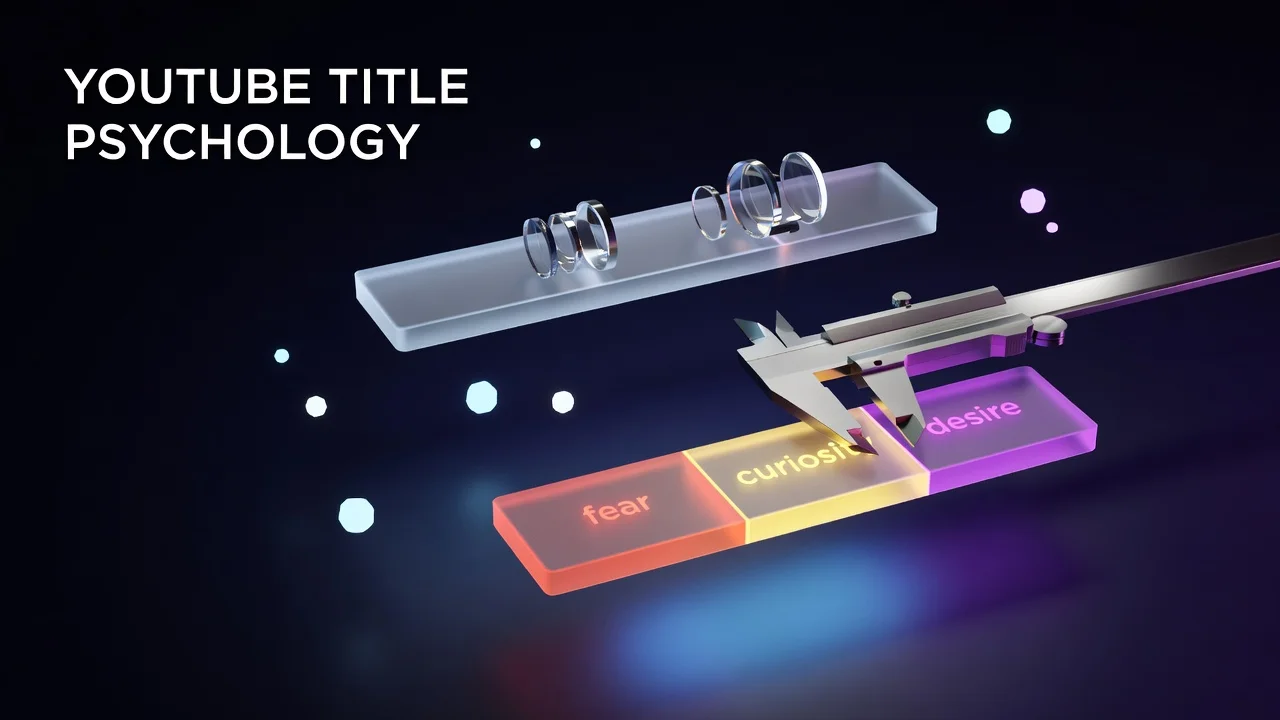
Nearly every title that outperforms in a niche is pulling on one of three levers. Fear titles offer protection from a loss — "Stop Doing This Before You Lose Your Savings." Curiosity titles open a gap the viewer can only close by watching — "Why Nobody Talks About This Chart." Desire titles promise a transformation or outcome — "How I Cut My Editing Time in Half." When you classify a channel's back catalogue by these three hooks and compare average views per category, the differences are rarely subtle: it's common to find one hook category pulling 2x to 3x the average views of another on the same channel, with the same production quality and the same audience. That gap is packaging, not content. Most creators lean unconsciously on one hook and never test the others. A finance channel drifts into fear, a tutorial channel into utility and desire, a commentary channel into curiosity. The lean itself isn't the problem — the problem is not knowing you have one. TubeAI's Dashboard classifies every synced video title into fear, curiosity, or desire automatically and charts the average views each category earns on your channel, which turns a vague hunch into a number you can act on in about a minute.
The three title hook categories, what they promise, and where each tends to work hardest
| Hook type | Psychological driver | Example structure | Works best for |
|---|---|---|---|
| Fear | Avoiding loss, risk, or a mistake | "The Mistake That's Costing You [X]" | Finance, health, career, warnings, news reactions |
| Curiosity | Closing an information gap | "Why [Surprising Thing] Actually Happens" | Commentary, documentary, explainers, mystery |
| Desire | Achieving a specific outcome | "How I [Result] in [Timeframe]" | Tutorials, transformations, business, fitness |
| Blended (fear + curiosity) | Risk plus an unanswered question | "Nobody Warned Me About [X]" | Personal stories, reviews, cautionary case studies |
Which Title Formats Actually Repeat Across Niches?
Structure does more work than wording. Look at enough outlier videos and the same skeletons keep reappearing: "I Tried [X] for [Duration]," "[Number] Things I Wish I Knew Before [Event]," "Why [Group] Is Wrong About [Topic]," "[Thing] vs [Thing]: Which Actually Wins." These templates survive because they front-load a curiosity gap and a scope the viewer can size up instantly. When a structural pattern shows up in dozens of videos across different niches and consistently beats its channels' own averages, that's evidence — not fashion. Length discipline matters just as much. YouTube allows 100 characters in a title, but the platform's own guidance in YouTube Help and the Creator Academy is consistent: front-load the most important information, because titles get truncated in browse and search surfaces, especially on mobile where roughly 40 to 60 characters survive. Think with Google's research on mobile-first attention reinforces the same principle — the decision happens fast and shallow. So the practical rule is to write the essential promise in the first 40 characters and treat anything after that as a bonus that may never be read. On SEO: keywords still matter, but keyword-stuffing a title at the expense of the hook is a trade most creators lose. Put the search phrase near the front if the video is search-driven, then spend the remaining characters on the emotional angle. TubeAI's Trending Formats surfaces title templates ranked by how often they appear and how much outlier lift they deliver, while Viral Vectors shows individual high-performing words alongside their best pairings and synonyms — so you can borrow a proven structure and then swap in words with measured pull rather than words that merely sound good.
Turning Title Data Into a Repeatable System
Titling is shifting from creative flourish to measurable discipline. Native thumbnail and title experiments have normalised the idea that packaging is testable, and creators who log which hooks and formats win on their own channel build an advantage that compounds with every upload. Ten deliberate title decisions teach you more than a hundred accidental ones. Build the loop. Keep a simple record of each video's hook type, format template, and resulting click-through rate. Within a couple of months, patterns emerge that no generic best-practice list could have told you — maybe your audience ignores numbered lists but rewards contrarian takes, or maybe desire titles carry your tutorials while curiosity carries everything else. One caution as tooling gets faster: generating fifty titles is easy, choosing well is not. The value isn't volume, it's the evidence behind the pick. Ground every choice in your own performance history plus what's demonstrably working in your niche, and titles stop being the weakest link in your upload process.